




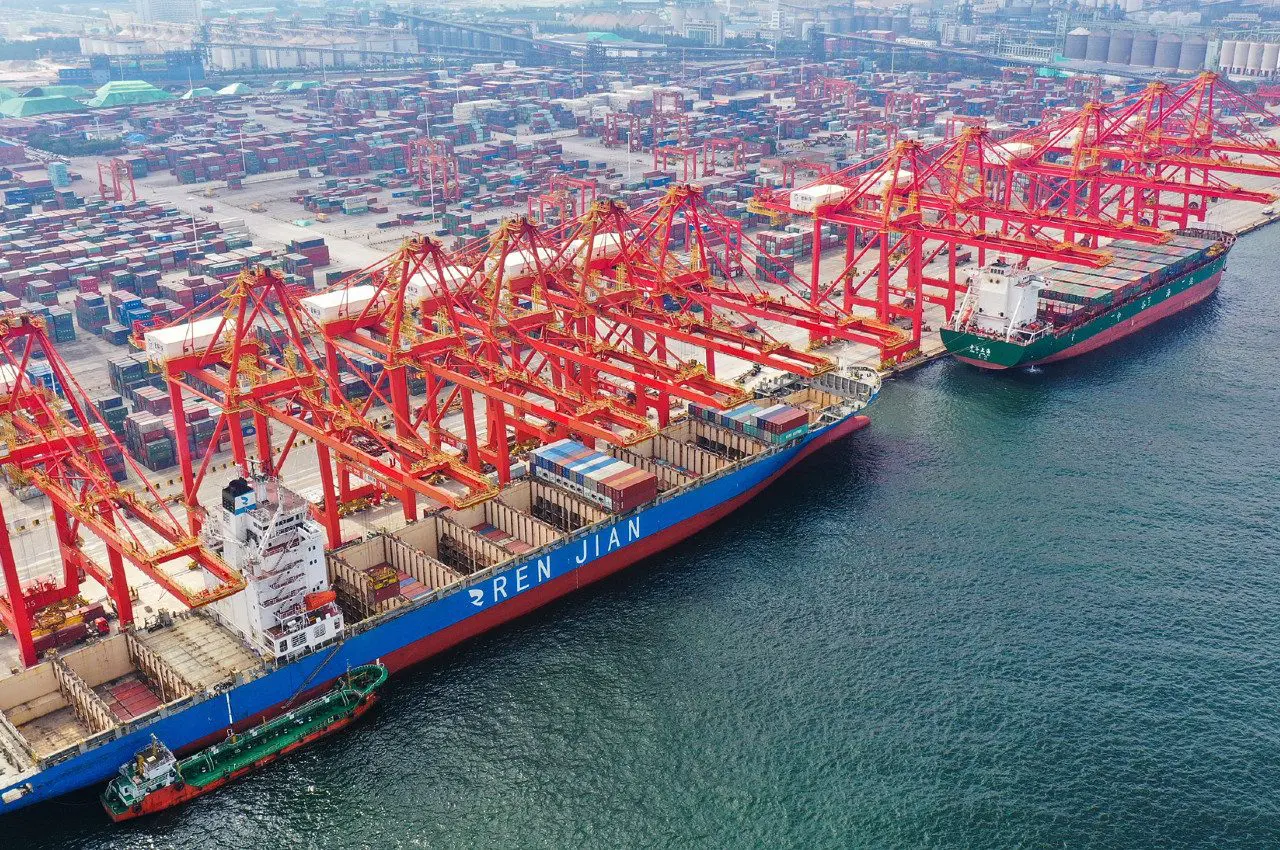

China is the world leader in the number of smart ports, both built and under construction
The port of Qingdao in China recorded an increase in the berth turnover of very large container ships, according to a report by state media company China Media Group.
The port, a subsidiary of Shandong Port Group and the second-largest maritime terminal for foreign trade in Shandong province, has handled ultra-large container ships more than 300 times.
FEATURED ARTICLE:Reverse logistics: achieve strategic management of your returnsREAD ARTICLE
Ultra-large container ships are typically 400 meters long, with a capacity of more than 20 thousand twenty-foot equivalent units (TEU).
The port has also handled 200-meter-long container ships more than 3,900 times, a 7% year-on-year increase, the media conglomerate stated.
Pandemic reduces workforce at China’s ports
The report highlighted how challenging it was to handle such a large volume of cargo amid the impact of Covid-19, particularly while operating with a reduced workforce.
However, the unloading rate at the port of Qingdao increased by 16% between January and November thanks to the port’s smart system.
Despite the disruptions to Asian maritime terminals caused by the pandemic, China’s main ports have experienced an increase in turnover levels.
In addition, according to the report, they have made significant progress in digital and smart construction, which has allowed them to play a leading role in the smart development of ports worldwide.
Figures for the Qingdao smart port
The port of Qingdao is the first in the world to feature a smart overhead rail transport system capable of handling 1.5 million TEU per year.
The system set a new world record in June by handling 67.76 TEU in a single hour, with an average of 60.18 TEU per hour.
That represents a 14.2% increase over its previous record.
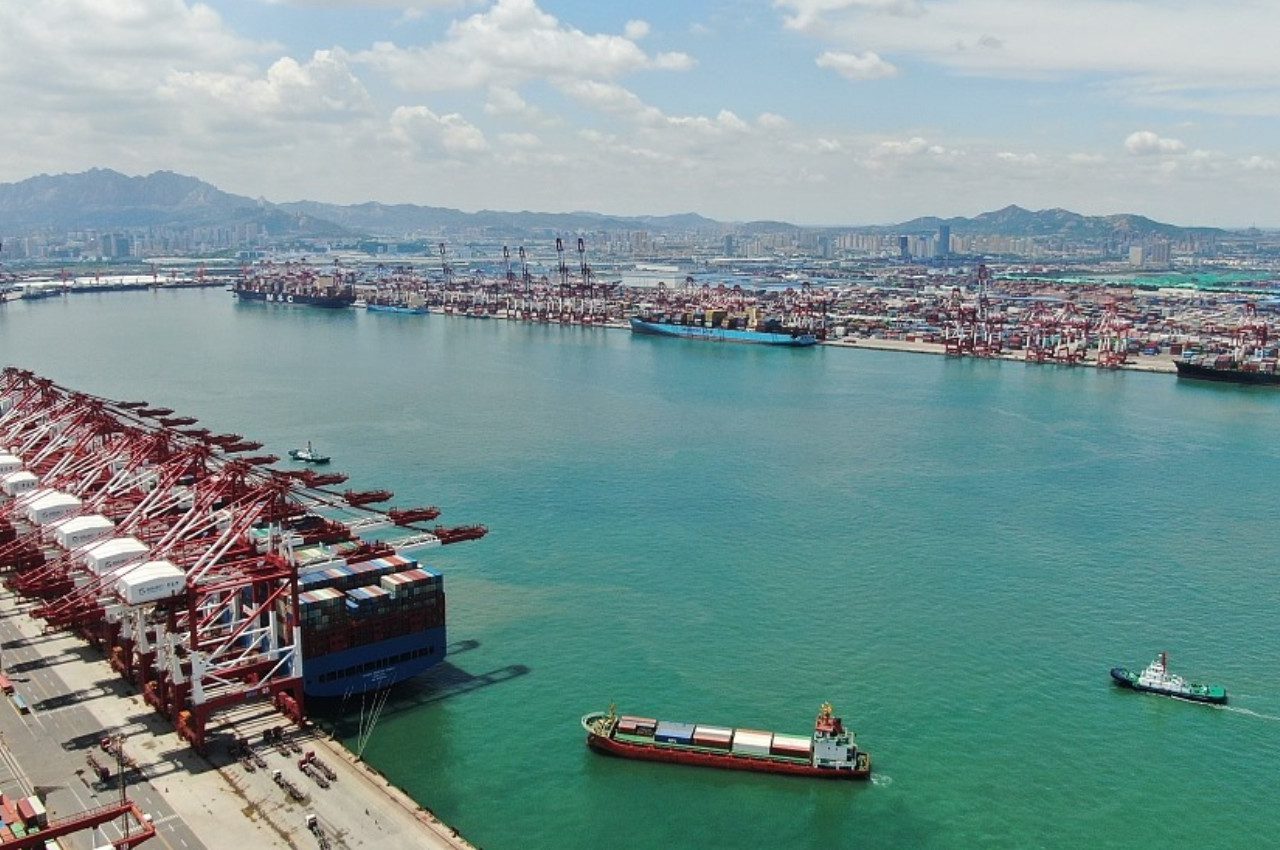
Chinese automated terminals
According to the Ministry of Transport, China is currently the world leader in the number of automated terminals, both built and under construction.
The main ports of Shanghai and Tianjin are equipped with automated gantry cranes or rails.
“Along with continued investment in domestic ports and a large number of high-tech companies, the concept and practice of smart port construction have been innovative,” said Mi Weijian, a professor at Shanghai Maritime University, in an interview with state news agency Xinhua.
Collaboration, key to the operation of smart ports
For large corporate ports, such as Shandong Port Science and Technology Group, internal cooperation is the key to upgrading existing facilities, the news wire added.
Moreover, such collaboration makes it easier to convert them into fully automated coastal container terminals.
That helps reduce overall costs by 70% compared with other newly built terminals.
“We now have traditional, semi-automated and fully automated terminals,” said Wang Yusheng, deputy general manager of the group.
“The loading and unloading of a vessel can be carried out at three different types of terminals, which maximizes the integration of terminal resources,” he added.
**Images courtesy of Shandong Port Group
Source: The Logistics World

