




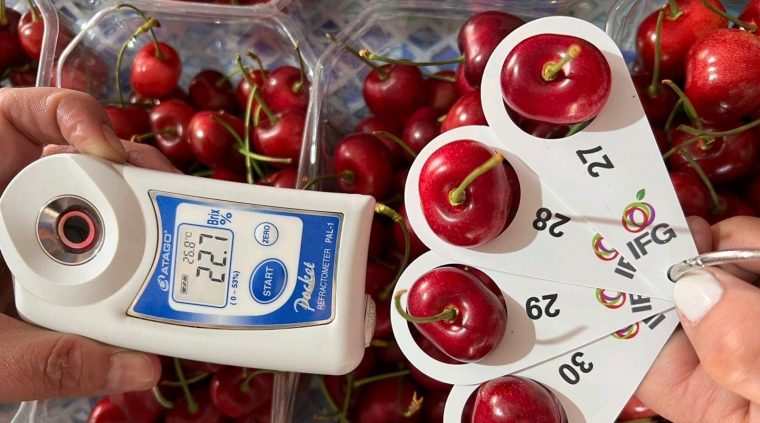

The fruit comes from a test block of IFG’s Cher-Ten variety, harvested by a grower in the upper reaches of the Coquimbo region who is testing the unprecedented possibility of producing cherries in that area.
In recent seasons, Chile’s earliest cherries had been harvested in the Coquimbo region: fields around the city of Ovalle — 300 meters above sea level — began the first shipments in week 42 (around October 20).
However, in the Andean foothills of the region, at nearly 800 meters of altitude, growers pulled off a surprise by managing to harvest cherries on October 15 (week 41), making them the earliest cherries in the country and probably the earliest in the southern hemisphere.
This achievement comes amid efforts by the country’s growers to bring forward their fruit shipments to China, given the earlier date of the Chinese New Year, which will be celebrated next January 22.
The ultra-early stone fruit from Vicuña is of the Cher-Ten variety (still without a commercial name), a genetic development by California-based company IFG, and was achieved in a test block with only 20 plants of that variety, with no more agronomic management than a trial unit of this kind typically receives. For that reason, the breeding company says it could deliver even earlier results if management practices were fine-tuned.
The grower that achieved this result is a company specializing in table grapes — whose name was withheld — and it would be an unprecedented harvest, considering that the areas where cherries are produced in the region lie close to Ovalle, thanks to its temperate microclimate and the relative humidity provided by its proximity to the sea.
According to Macarena Villasante, Technical Manager for Chile and Peru at IFG, the grower’s plan is to enter the cherry business given the trial results, even though there is no previous experience in Vicuña.
This result also demonstrates that IFG varieties such as Cher-Ten deliver results with between 150 and 200 chill hours.
“Managing this variety is still a work in progress, because it has to be looked at case by case, depending on conditions,” Villasante tells this outlet, also pointing to the cultural component of growers who have traditionally focused on grapes, citrus or avocados, are unfamiliar with cherry trees and have had to learn their physiology, because cherry trees take much longer to come into production than a vine, for example.
The production of these cherries in Vicuña also comes in a year in which cherry growers in Ovalle — where the main producers are Valle Arriba and Sutil — pushed their harvests back a week this year due to a colder spring than budgeted, which slightly delayed color development.
In this regard, Jorge Astudillo, head of production at Valle Arriba, told Redagrícola that “the IFG news is a wake-up call for all of us, because we cannot stand still. It is important to understand that all of this is very dynamic, and that technology and genetic developments will always keep shifting the landscape,” says Astudillo about this productive surprise, adding that one of the advantages of the area — apart from not depending directly on the Chinese New Year — is that “the first one to take the right step is the first one to strike.”
Source: Red Agricola


