




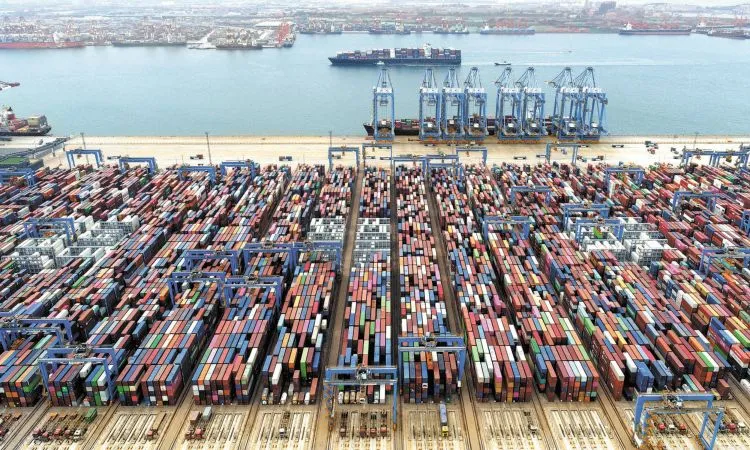

The Asian country’s share rose from 14.9% in 2011 to 19.9% in 2021, and during the first four months of 2022 that percentage reached 20.5%.
China broke its record share of Mexico’s product imports, both for the whole of 2021 and in the first four months of 2022, according to data from the Bank of Mexico.
Last year, China surpassed the 100-billion-dollar barrier in exports to Mexico for the first time (101 billion dollars), thereby reaching a 19.9% share of total Mexican imports.
Then, from January to April 2022, Mexico purchased products from China worth 38.114 billion dollars, with a 20.5% share of that same relationship.
As part of the recent context, on June 2, 2021, ministers and senior officials of the 11 member countries of the Comprehensive and Progressive Agreement for Trans-Pacific Partnership (CPTPP) established a working group for the United Kingdom’s accession to the trade agreement, and China and Taiwan formally applied to join the CPTPP on September 16 and 22, 2021, respectively.
Likewise, in 2021, Mexico began the process of modernizing the Agreement on the Promotion and Reciprocal Protection of Investments (APPRI) with China.
With ups and downs, China’s share of Mexico’s total product imports rose from 14.9% in 2011 to 19.9% in 2021.
China exports to the Mexican market above all telephones, liquid crystal display devices, computer parts, integrated electronic circuits, telephones, auto parts, electrical transformers and parts for telephone and television transmitting and receiving equipment.
As for the Chinese economy, the European Central Bank (ECB) projects that the highest recorded incidence of Covid-19 cases since the beginning of the pandemic will curb growth in the short term.
While Chinese activity appeared relatively strong in January and February, the rapid rise in the number of Covid-19 cases in March triggered widespread lockdowns, which are significantly holding back growth. And local lockdowns imposed by the authorities could further disrupt important supply chains.
The decline in traffic congestion in key port and financial cities such as Shanghai and Shenzhen, which account for around one-sixth of China’s exports, suggests to the ECB that growth momentum was slowing at the end of the first quarter. With cases rising and major cities locked down, the economy is likely to continue slowing in the second quarter of 2022.
In the bilateral relationship, the protocol for exporting Mexican sorghum to China was agreed in 2020, along with the expediting of work to conclude the sanitary protocols for pork and beef offal, as well as the certification of Mexican meat plants and the access of Mexican fishery products to China.
Later, the IX Meeting of the Mexico-China High-Level Group was held on August 19, 2021, and prior to that meeting, meetings were held by the cooperation working subgroups for the promotion and facilitation of bilateral trade (August 17) and investment (August 18).
Among the topics addressed were the efforts to conclude the sanitary protocols of interest to Mexico, as well as the certification of Mexican meat plants.

Source: El Economista


