




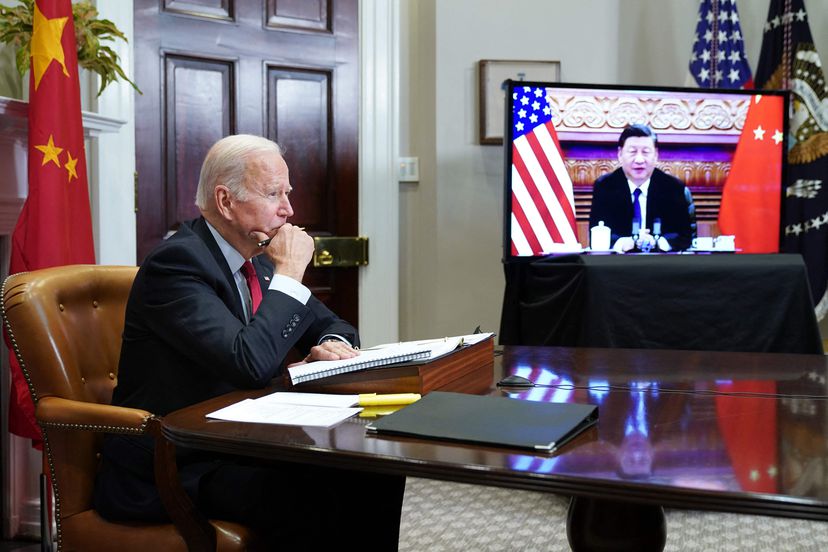
Biden warns Xi of the “consequences” if China helps Russia in its “brutal” attack on Ukraine

The Chinese president asks his U.S. counterpart for the allies to hold talks with Moscow to “resolve the causes” of the war
The differences between the United States and China in the way they see the world became evident this Friday in each side’s account of the nearly two-hour video call between their presidents, Joe Biden and Xi Jinping. They had arranged the meeting to address the Russian invasion of Ukraine, beyond the other issues that define a relationship marked by growing tension. Washington described a “frank” exchange in which Biden warned of “the implications and consequences” of China “providing material support to Russia as it conducts brutal attacks against Ukrainian cities and civilians.” According to Beijing—whose state news agency, Xinhua, reported on the call as it unfolded—the conversation, described as “constructive” and “candid,” focused on how to end the war, as well as on the request that the United States, together with NATO, hold talks with Russia to resolve “the causes” of the aggression. Beijing’s official statement makes no mention of the warnings issued by Biden.
The White House, usually quicker, took almost four hours to offer its summary of what happened in a virtual meeting preceded by tension, after Washington had signaled that Biden was going to warn his counterpart against any temptation to help Russia in the war in Ukraine. According to Washington, the president underscored “his support for a diplomatic solution to the crisis.” “The two leaders also agreed on the importance of keeping lines of communication open,” the official statement adds, in which the Biden Administration reiterates “that U.S. policy on Taiwan [and on Chinese aspirations over that territory] has not changed.” “We continue to oppose any unilateral change to the status quo,” the text concludes.
“The crisis in Ukraine has deteriorated to a point we do not like to see,” declared the Chinese president, who said the immediate priorities for tackling the conflict should be the continuation of dialogue and negotiations, “avoiding civilian casualties, preventing humanitarian crises, and ending the war as soon as possible.” According to the Chinese version of the meeting, Xi used the word “war,” which his government has avoided—as it has the term “invasion”―to refer to the Russian attack on Ukraine. China, its head of state noted, “plays a constructive role” in resolving the crisis and is willing to continue providing humanitarian aid to Ukraine and other countries that need it. Both leaders agreed to further contacts to continue discussing the evolution of the crisis.
As he had indicated in his conversation—also virtual—with France’s Emmanuel Macron and Olaf Scholz at the beginning of this month, Xi called for international support for the peace talks taking place between Kyiv and Moscow. “The more complicated the situation, the more necessary it is to remain calm and rational,” he maintained, after calling for “political courage.” “Relations between states cannot reach the level of confrontation. Conflict and confrontation benefit no one,” he added.
Xi also demanded the lifting of the sanctions that the West has imposed on Russia as punishment for the invasion, which the Chinese government believes, “if increased,” will harm the global economic recovery. “They will trigger serious problems in global trade, finance, the energy sector, food, and supply chains, worsening the difficulties of the world economy and causing irreparable losses.”
The solution to the crisis, in the Chinese leader’s view, must also involve opening talks between NATO and the United States on one side and Russia on the other, “to resolve the origin of the Ukrainian crisis and address the security concerns of both Russia and Ukraine.” Since the beginning of the invasion, Beijing has avoided condemning Moscow, its strategic partner, and has blamed Washington and the Atlantic Alliance for the conflict, for failing to respond to the “legitimate security concerns” of Vladimir Putin’s government.
To resolve the conflict in the long term, Xi said, it is necessary to “show mutual respect among the great powers, abandon the Cold War mentality, avoid confrontation, and gradually build a regional and global security architecture that is balanced, effective, and sustainable.”
The two leaders also addressed the tensions in their bilateral relationship, increasingly that of two rivals. Biden, according to the Chinese version, assured that he does not seek confrontation with China and does not support “Taiwan independence.” The situation of the self-governing island is one of the major sticking points in the bilateral relationship: Beijing considers the island an inalienable part of its territory and accuses the United States of encouraging pro-independence sentiment in that democracy.
After Biden’s statement, Xi adopted a conciliatory tone. “There have been differences in the past and there are today. The key is to manage those differences. A stable and well-developed China-U.S. relationship is beneficial to both sides,” declared the leader of the Asian giant.
The statement distributed by Xinhua does not allude to what was anticipated as one of the main focuses of the meeting: Biden’s intention to try to dissuade Beijing from aligning itself with Russia in the Ukrainian war.
Washington had announced hours before the conversation that it was going to warn Beijing of “serious consequences” if it tangibly supports Russia’s “unjustified” attack. This week the Biden Administration accused the Asian giant of being inclined to provide help to Moscow, which in turn had reportedly asked Beijing for economic and military assistance for the war. “We are concerned that they are considering directly assisting Moscow with military equipment that would be used in Ukraine. Biden will make clear to Xi that China will bear responsibility for any actions taken to support Russia’s aggression, and we will not hesitate to impose costs,” U.S. Secretary of State Antony Blinken said on Thursday. “We are concerned that China is considering providing Russia with direct military assistance,” he added.
But the U.S. government does not only fear assistance on defense matters. It is also concerned about the possibility that the world’s second-largest economy may try to help its strategic partner evade the sanctions imposed by the United States and its allies. Blinken’s is the most direct warning Washington has issued to Xi’s government since the beginning of the Russian invasion of Ukraine on February 24.
Jen Psaki, White House press secretary, explained in her daily briefing on Thursday that the two leaders “have a lot to discuss” and that the expectation was that the tone of the conversation would be “frank and direct.” She also said the call, the fourth exchange between them and undoubtedly the most tense, was prepared during the face-to-face meeting in Rome between White House National Security Advisor Jake Sullivan and Chinese State Councilor Yang Jiechi, which lasted seven hours and was described by Psaki as “extraordinarily intense.”
The Biden-Xi conversation comes amid growing tensions between two increasingly rival countries. China has flatly denied the U.S. accusations about its intentions to assist Russia, which it has called “disinformation.” This Friday, Wendy Sherman, Deputy Secretary of State and Washington’s second-ranking diplomat, warned on CNN’s morning show that Beijing must decide whether or not “it wants to stand on the right side of history.”
The two leaders last spoke directly in November, in a meeting that was also virtual and that both countries carefully avoided calling a “summit.” Xi then called Biden an “old friend”; the American did not return the compliment. Xi said this Friday, according to the Xinhua agency, that since then “the international situation has changed enormously.”
So far it is not clear what kind of “consequences” Washington has in mind to punish Beijing if it concludes that that government is helping Moscow with anything more than the passive complicity it has been demonstrating since the beginning of the invasion. Approving sanctions against the world’s second-largest economy could have serious effects on the global stage. And in the United States: despite the tariffs with which the two countries have been punishing each other since 2018, the trade relationship between the two giants is the largest in the world.
The gradual distancing between Washington and Beijing has been matched by increasingly close relations between China and Russia, two countries united by the perception of the United States as the common rival, a shared view of human rights, the desire for a new world order that grants them a central role, and economies and spheres of influence that are almost perfectly complementary.
Xi and Russian President Vladimir Putin sealed that rapprochement with a joint statement in which they assert that cooperation between their two countries “has no limits”, during their February 4 meeting in Beijing. China is Russia’s main trading partner. Their bilateral trade hit a record in 2021, a year in which it grew 36% to 147 billion dollars. In addition, the two powers have recently agreed to step up the supply of coal and wheat, two of the products proving crucial in the current war.
A neutral position tilted toward Moscow
Since the beginning of the Russian invasion, 20 days after that meeting and just after the Winter Olympic Games in Beijing concluded, China has adopted a position of neutrality tilted toward its strategic partner. It has not condemned the war and avoids calling the Russian attack an “invasion.” Instead, it accuses NATO and the United States of having precipitated the conflict by ignoring Russia’s “legitimate security concerns.”
But it has also made gestures toward Ukraine, to whose refugees it has sent a shipment of humanitarian aid worth five million yuan, or 717,000 euros. It says it respects the sovereignty and territorial integrity of states, and its ambassador to the former Soviet country promised this week in Lviv—where the diplomatic mission’s staff has relocated during the conflict—that China “will never attack.”
And, although it opposes the international sanctions against Russia, which it considers “illegal” and “unilateral,” so far it has shown signs of respecting them. It has also declared its support for the peace talks between Kyiv and Moscow and expressed its willingness to play a role “in its own way” alongside the international community to prevent “tensions from worsening or even spiraling out of control.”
Source: El País


