





China’s top ten ports handled a combined 244.9 million TEU during the first ten months of 2022 through October 30, a 4% increase compared to the same period last year, reports Port Technology. Last year’s container handling data has given us a clear picture of which ports will lead the way into 2023.

Although official data from the Ningbo Shipping Exchange for the last two months of the year is still pending, China’s maritime industry had a very successful and busy year in 2022.

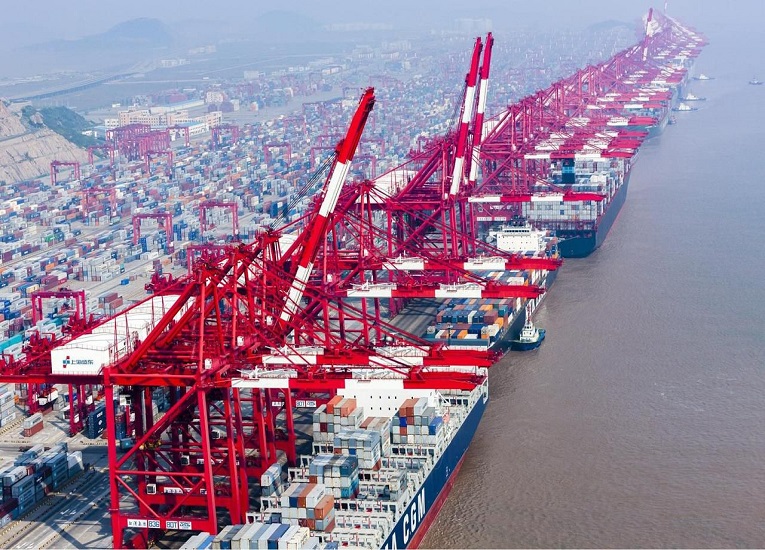
The Port of Shanghai, which continues to set the pace in China’s maritime sector, once again tops the list of Chinese ports; having overtaken the Port of Singapore as the largest port in the world, it now has a total of five operational zones.

This port giant also topped the previous ranking, handling an astonishing 39,080,000 TEU in the first ten months of 2022. As in 2021, it was the only port to surpass 30 million TEU so far this year. Although the port saw an 8.4% increase from 2020 to 2021, percentile growth into 2022 was only 0.2%.

The Port of Shanghai has opened operations for an empty container transportation hub. According to government sources, the new hub, which can handle 3 million TEU annually, will increase the port’s cargo handling capacity, foster domestic and international trade, and consolidate Shanghai’s position as a hub for international shipping.

The Port of Ningbo-Zhoushan, which previously ranked third in 2020, remains China’s second-busiest port this year. From January to October 2022, the Zhejiang province port handled 28,890,000 TEU, an 8.1% increase over the same period in 2019. However, compared to 2021, when the annual increase was 11%, this indicates another slowdown in growth.

The Port of Shenzhen, which used to be the country’s second busiest, now ranks third, posting growth of only 1.7% since 2021 to handle 24,180,000 TEU, a 9% decline from the container handling growth experienced from 2020 to 2021.
The Port of Qingdao climbs one spot from last year’s list to fourth, consolidating its place among China’s top five ports. Between January and October of this year, this major Yellow Sea port handled 21,390,000 TEU, representing a year-on-year increase of 7.6%. Despite rising in this ranking, the Port of Qingdao’s percentile increase was 2.7% lower than in 2021, when it achieved a 10.3% increase over 2020.
The Port of Guangzhou, which previously ranked fourth among China’s busiest ports, has now fallen to fifth place. This Guangdong province port handled a total of 20,270,000 TEU from January to October 2022, an increase of 1.8%, the joint second-lowest percentage growth since 2021 of all the ports on this list.
The main maritime gateway to China’s capital is provided by the Port of Tianjin, the largest port in northern China. In sixth place, the port handled a total of 18,360,000 TEU, 4.3% more than the previous year.
In seventh position, the Port of Xiamen, located along the Jiulongjiang River in southern Fujian, is a deep-water port crucial to the Chinese economy. The port handled a total of 10,180,000 TEU during the year, a throughput increase of 1.8% over the first ten months.
The Port of Beibuwan, also known as the Beibu Gulf Port, is a seaport in China’s Guangxi province, owned by the Guangxi Beibu Gulf International Port Group. In eighth position, the port experienced the highest year-on-year growth of all the ports on this list in the first ten months of 2022, with a total throughput of 5,580,000 TEU, a huge 17% increase over the same period in 2021.
Along with its increased container handling, the Port of Rizhao has seen recent success and is China’s ninth-busiest port. Container traffic at the deep-water seaport on the coast of the city of Rizhao rose 12.7% from the same point in 2021, handling 4,860,000 TEU
In tenth position, located near the mouth of the Qiangwei River in China’s northern Jiangsu region, Lianyungang handled 4,440,000 TEU in the first ten months of 2022, representing year-on-year growth of 6.4%.
Source: Mas Container


