




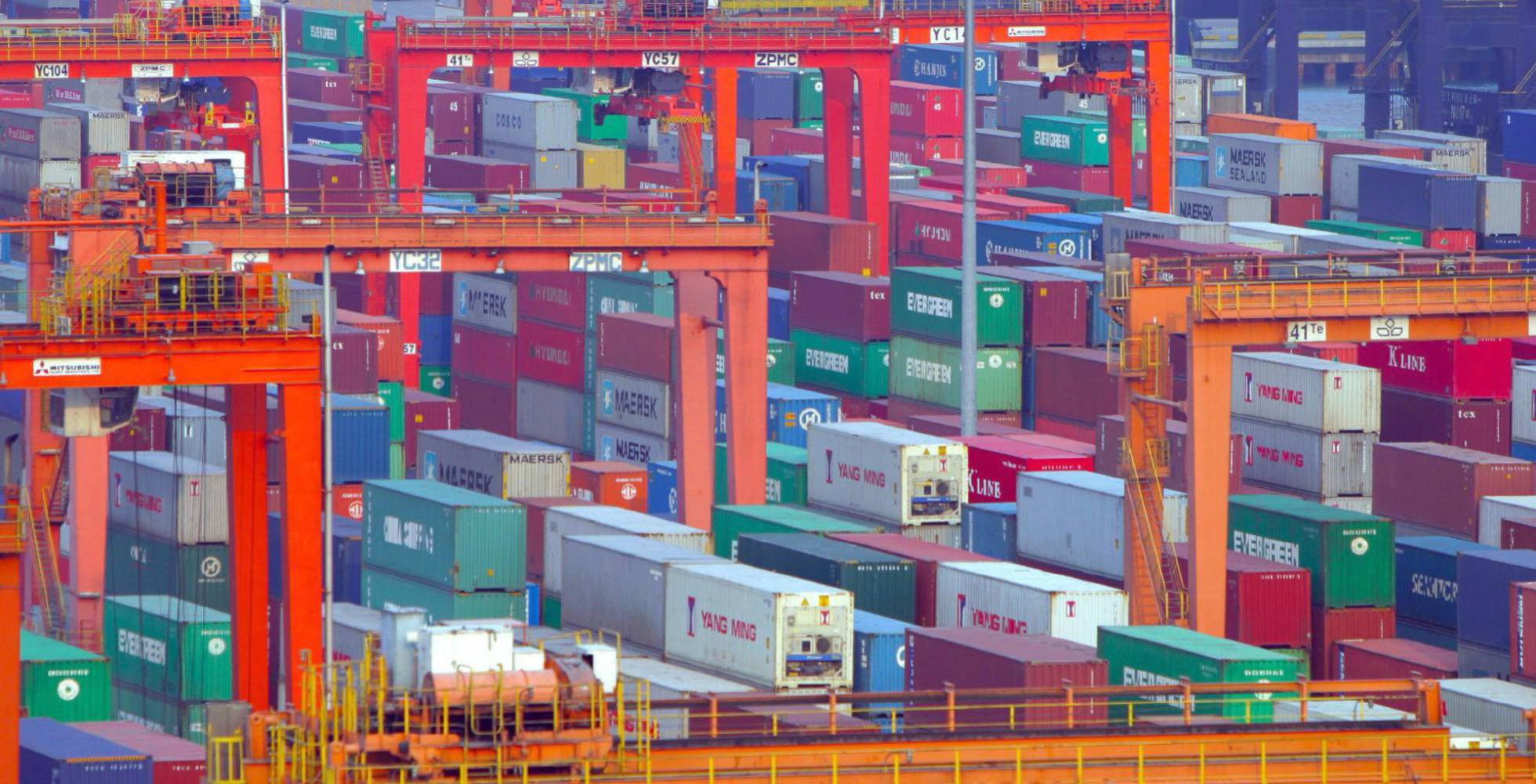

Operators are forced to send goods by sea while shipping lines anticipate rising prices and shrinking capacity
The price increases and container shortages suffered last year by the companies most dependent on importing goods from China threaten to repeat themselves, although this time the origin is quite different. If in 2021 the main cause was China’s stockpiling effect, aimed at guaranteeing the consumption needs of 1.2 billion inhabitants, almost four times the population of the entire European Union, this year the trigger is the Russian invasion of Ukraine. The deployment of Russian armed forces on Ukrainian territory has brought the rail lines crossing Ukraine to a standstill, while international economic sanctions on Russia have led the Russian government to also close part of those routes.
Supply chain
The consequence is that the rail route linking Asia with Europe, known as the Silk Road, which China promoted at the beginning of the previous decade as an alternative to sea routes, has been interrupted sine die, and that has forced the major logistics operators working in the area to turn unanimously to sea routes, which could well unleash another spike in ocean freight rates (the price paid to transport goods by sea) and a shortage of containers to move goods to Europe.
Ocean freight rates rose in March, a month in which they usually fall
Initial estimates suggest that up to one million containers have had to change their routes and opt for sea shipments from China, which adds a further point of pressure given the difficulties of guaranteeing the supply chain of a global company in a shifting context of prices and capacity availability. Kuehne+Nagel International AG, one of the largest logistics companies in the world, has stopped serving the rail line between China and Europe, as acknowledged to Bloomberg by Marcus Balzereit, the company’s vice president for Southeast Asia.
Rail as an alternative
In the previous crisis, which occurred in the last quarter of 2021, one of the hardest-hit sectors was consumer goods, heavily conditioned by the Christmas season. In those months, Oliver Giner, head of the Foreign Promotion department of the Spanish Association of Toy Manufacturers, denounced that the cost of a container transported by ship had multiplied fivefold, going from 3,000 to 15,000 dollars. “If orders used to take four to five weeks to arrive from Asia, they now take a minimum of ten weeks,” Giner stressed. That delay forced toy manufacturers to bring purchases forward massively, albeit at higher prices, so margins at the close of the Christmas season were lower. Francisco Aranda, president of the logistics employers’ association UNO, notes that in the final months of last year, traffic on the rail route doubled and even nearly tripled toward the end of 2021. “It was a very attractive alternative to the congestion detected in Chinese ports,” he stresses.
15% of the crews on cargo ships are Russian and Ukrainian
Although none of its members has reported problems in the current supply chain for buying and selling goods in China, Aranda acknowledges that something must be going on. “Between mid-January and the end of February, which coincides with the Chinese New Year, port traffic in the Asian giant hits annual highs on strong domestic demand, and from the first week of March it falls sharply. However, ocean freight rates rose steadily in March. In the last week alone they increased 3.3% over the previous one. That means there are renewed supply tensions and that port congestion is increasing,” he remarks.
Although none of its members has reported problems in the current supply chain for buying and selling goods in China, Aranda acknowledges that something must be going on. “Between mid-January and the end of February, which coincides with the Chinese New Year, port traffic in the Asian giant hits annual highs on strong domestic demand, and from the first week of March it falls sharply. However, ocean freight rates rose steadily in March. In the last week alone they increased 3.3% over the previous one. That means there are renewed supply tensions and that port congestion is increasing,” he remarks.
Staff shortages
Aranda adds that the current situation is compounded by two other problems that could create bottlenecks in moving goods by sea from China to Europe. “Of all the crew members engaged in the seaborne transport of goods, 11% are Russian and 4% are Ukrainian, so the invasion is causing an additional problem of staff shortages.” The president of UNO also highlights the fact that the US dockworkers’ labor agreement expires on July 1 and will have to be renewed. “The last time the agreement lapsed there were four months of conflict that led to strikes, supply disruptions and bottlenecks. That would be disastrous for US ports, which are currently at full capacity. If the recent conflicts are repeated and there is no agreement, it is possible that not a single ship will enter or leave a US port.”
DEPENDENCE ON GOODS FROM THE ASIAN GIANT
Reshoring. In the previous crisis of 2021, the president of the logistics employers’ association UNO advocated, once anti-covid protocols were relaxed and factories returned to full capacity, re-planning the supply chains of each industry. “We have asked the Government for a plan to relocate industry to Spain in order to avoid over-dependence on China and to have more room to adapt to a changing industry.”
Freight rates. Spanish industry has been caught in a perfect storm for the past year. Two of the factors that most damage its competitiveness (rising energy prices and the extra cost of ocean freight) have not stopped growing over those twelve months and have pushed many activities against the wall. One of them is tile production, which has a clear export focus, since it sells 90% of what it produces to other countries. Estimates by the Spanish Association of Ceramic Tile and Flooring Manufacturers (Ascer) show that energy costs account for 13.3% of the expenses of all member companies. These companies’ gas consumption is equivalent to 7% of industrial gas consumption in Spain. Meanwhile, freight rates for transporting goods from China rose 23% in 2020, another 47% in 2021, and in March they climbed 3.3% in the third week.
Source: El País


