




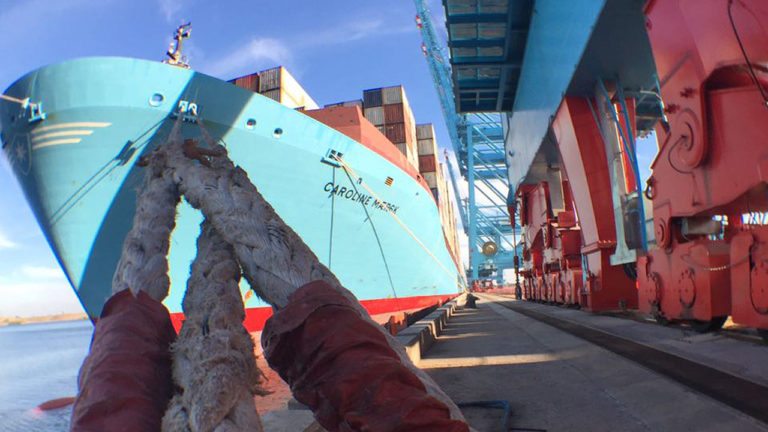

Temporary port closures due to the pandemic and the container shortage are driving up the price of shipping goods from China.
The world’s shipping lines are making more money than ever because, as the Covid-19 pandemic allowed trade to reopen, freight costs increased fivefold, including on routes from Chinese ports to Lázaro Cárdenas, Michoacán.
“The cost of Asia (China)-America freight has shown an increase of more than 575% comparing January 2020 with November 2021,” reveals Jorge Luis Cruz Ballado, director general of the National Port System Administration of Lázaro Cárdenas (APILAC).
“One of the most notable effects of the pandemic has been the breakdown of supply chains, also known as the container crisis, generated by the massive temporary port closures over several months of 2020 — the containers are not at the ports — as well as a rise in product demand and the use of containers as storage,” he says.
In January 2020, when the first Covid-19 infections were emerging, moving a 40-foot container from the Chinese ports of Shanghai, Ningbo, Yantian, Xiamen, Qingdao or Hong Kong to Lázaro Cárdenas cost only 2,002 dollars per container, according to the admiral of the Ministry of the Navy (Semar).
The shipping lines APM-Maersk, Mediterranean Shg Co, Cosco Group, CMA CGM Group, Hapag-Lloyd, Ocean Network and Evergreen Line were charging 13,500 dollars to bring that same box loaded with goods from China to Mexico by the third week of November 2021, the official says.
In October 2021, the cost of shipping a 40-foot container between China and Mexico reached more than 14,265 dollars.
China has Alibaba, JD.com and Pinduoduo among the world’s top five e-commerce companies by turnover, which has driven freight demand. The United States has Amazon in second place and Canada has Shopify.
“There is no certainty as to when freight (rates) will return to their pre-pandemic level, which depends on the stabilization of production or the return of demand to pre-pandemic levels,” notes the official from the government of Andrés Manuel López Obrador.
Nor is there any sign, he added, of massive container construction, given that the current fleet is sufficient for the volumes handled before the pandemic, comments the director general of the National Port System Administration of Lázaro Cárdenas.
Currently, 80% of containers are moved by the shipping lines APM-Maersk, Mediterranean Shg Co, Cosco Group, CMA CGM Group, Hapag-Lloyd, Ocean Network and Evergreen Line.
“This concentration in the shipping sector creates pressure to reduce rates and services, as well as to speed up the clearance of goods, and thus 80% of container cargo capacity is concentrated in seven shipping lines,” the executive explained in the webinar entitled “Variation in the cost of ocean freight: causes and outlook,” organized by the Red PBIP México Internacional and the Inter-American Committee on Ports (CIP) of the OAS.
The total number of containers in use has not been affected; rather, they are sitting in storage, interrupting the normal logistics flow at port terminals, Cruz Ballado states.
The official points out that the container availability crisis was aggravated by the churn of the pandemic and the increase in demand and online purchases.
He clarifies that the Lázaro Cárdenas port administration has kept handling and maintenance costs unchanged so far this year despite this problem of port congestion and the high cost of freight between China and Mexico.
“APILAC has handled higher containerized cargo volumes compared with the figures for 2019,” he adds.
“Due to the effects of the delays at the ports of Long Beach and Manzanillo, Colima, shipping lines have been leaning toward Lázaro Cárdenas, since we have a port terminal of excellence in containerized cargo handling recognized by the World Bank,” Cruz Ballado emphasized.
Source: Forbes


