





Beijing and Moscow are drawing closer because they need each other more than ever.
Something sobering is becoming apparent as U.S. policymakers begin to assess a new and harsher international environment. Officials in Washington are recognizing that the ties between Russia and China, long flimsy, have the potential to reshape world politics.
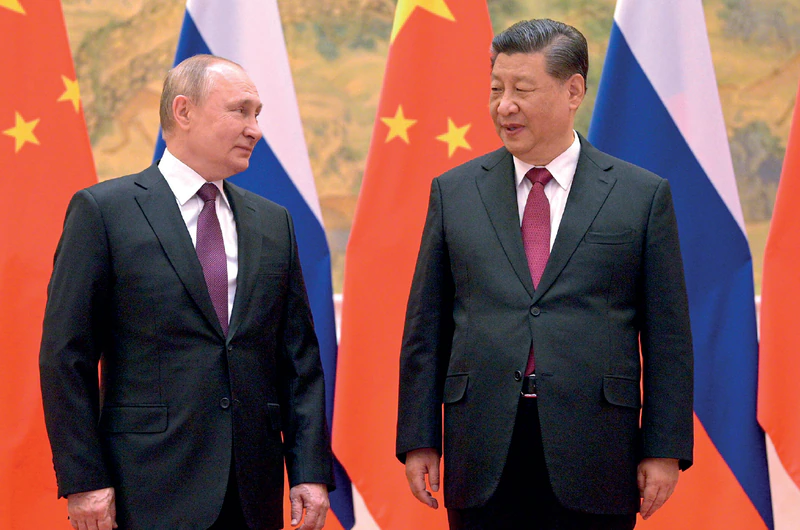
The run-up to Vladimir Putin’s invasion of Ukraine focused their minds on the problem. In early February, as American warnings about a possible Russian attack grew increasingly urgent, Putin visited his Chinese counterpart, Xi Jinping, for the Winter Olympics in Beijing. During the visit, the governments of China and Russia issued a joint statement of more than 5,000 words praising a partnership with “no forbidden areas.”
The document, filled with Russia’s and China’s favorite talking points, appeared to be a call for nations to establish spheres of influence in their regions, a senior U.S. official warned. Defense Department spokesman John Kirby said the document signaled China’s “tacit support” for Russian threats against Ukraine.
Hoping that China might urge Putin to be cautious, U.S. officials decided to share downgraded intelligence about Russia’s troop buildup with the Chinese government. In a series of meetings at the Chinese Embassy in Washington and phone calls with China’s Foreign Minister, Wang Yi, officials went over Russia’s plans in detail and warned about the implications for global security, according to two senior officials who asked not to be identified.
During these meetings, China expressed skepticism that Putin would invade, U.S. officials say. Worse still, the Chinese shared a confidential diplomatic exchange with Russia, warning that government that China believed the United States was trying to sow division between the two countries. “By releasing false information, the United States aims to blame and smear China,” says Liu Pengyu, spokesman for the Chinese Embassy in Washington. “China supports and encourages all diplomatic efforts leading to a peaceful resolution of the Ukraine crisis.”
President Joe Biden was furious over China’s attitude, according to a person familiar with his thinking. A senior official said it was clear that successive U.S. administrations had underestimated the depth of the ties between Putin and Xi, who share a strong sense of grievance over the United States’ place in the world. A senior defense official says the events represented a clarifying moment about the nature of the Chinese regime.
The result is that U.S. government officials will have to start thinking about joint Russian-Chinese responses to a host of global challenges. David Shullman, former deputy national intelligence officer for East Asia at the National Intelligence Council, says the Russia-China partnership would now affect the United States’ ability to address issues including the security of East Asia and Europe, democratic resilience, and the defense of the global financial system.
“The United States will face greater challenges in all of these domains in the wake of Russia’s invasion of Ukraine, and each of them will be harder because of a China-Russia relationship that will only deepen in the coming months as Russia becomes further isolated internationally,” he said.
Recent events are the culmination of a long process of Russian-Chinese rapprochement. After a tense and at times violent relationship during much of the Cold War, Russia and China began drawing closer during the 1990s, signing a treaty of “Good-Neighborliness and Friendly Cooperation” in 2001. Both were angered by U.S. dominance in the post-Cold War era and began calling for the “democratization” of global politics: code for a world less centered on U.S. leadership and alliances.
The countries’ push for partnership accelerated when Putin faced isolation after his annexation of Crimea in 2014 and gradually overcame his doubts about selling advanced weapons to China. Beijing sympathized with Moscow, having also been a target of American economic pressure.
In October 2019, Putin announced that Moscow would help China develop an early warning system to counter missile attacks. In February 2021, China’s Foreign Minister Wang publicly called for a Sino-Russian relationship with no restricted areas of cooperation. In October, the two nations held extensive joint naval exercises in the Sea of Japan. Tensions persist in the two countries’ partnership. U.S. officials are convinced that many Chinese officials below Xi have deep doubts about Russia’s invasion of Ukraine, according to two senior Administration officials.
In public, China has begun urging Russia to be cautious. In a March 1 call with Ukraine’s Foreign Minister, Dmytro Kuleba, Wang said he was “extremely concerned” about harm to civilians. China’s hesitation may reflect that the country has much to lose in the crisis. It has spent decades trying to convince European elites that they have little to fear from a rising China, a claim that tacit support for Russian actions threatens to undermine. Moreover, China has traditionally placed great importance on its support for state sovereignty in international affairs, partly to help blunt criticism of its domestic policies. Here too, Putin’s invasion of a sovereign state threatens to undermine the principles China has laid down. On top of all this, Xi’s priorities this year are focused mainly at home, as he seeks to secure a third term at the head of the Chinese Communist Party. He does not need crises abroad to distract him.
On the Russian side, there is the possibility that Putin will eventually grow uncomfortable with a relationship in which he is clearly the junior partner. China accounted for 17.3 percent of global Gross Domestic Product in 2020, while Russia accounted for only 1.7 percent, according to World Bank data. Such an imbalance could lead China to ask for favors that make Russia uncomfortable, on sensitive issues such as Taiwan and the South China Sea. Russia also has high expectations for the partnership: it will need help getting around sanctions in areas where Beijing has been reluctant to offer assistance. “Russia will become increasingly dependent on China going forward, and that dependence will give Beijing leverage it could use to secure Russian backing for its regional and global ambitions,” says Bonnie Glaser, director of the Asia program at the German Marshall Fund.
Neither side is formally obligated to do anything for the other, because they stopped short of signing a formal mutual defense treaty. Much will depend on Xi’s assessments of how the war in Ukraine plays out. “He may conclude that aligning with Russia carried unexpected costs; that would be a welcome outcome,” says Glaser. “But if Xi Jinping believes that strengthening ties with Russia is the right choice and doubles down on that decision, the United States and its allies will face greater challenges in the future.”
Source: El Financiero


