




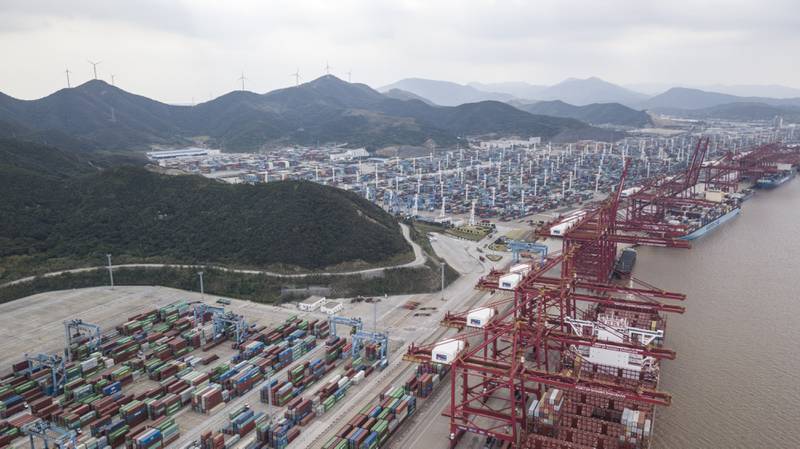

The partial shutdown of the world’s third-busiest container port raises fears over its impact on global trade.
China partially shut down the world’s third-busiest container port after a worker became infected with SARS-CoV-2, threatening further damage to already fragile supply chains and global trade as a key shopping season approaches.
All inbound and outbound container services at the Meishan terminal in the port of Ningbo-Zhoushan were halted on Wednesday until further notice due to a “system disruption,” according to a statement from the port.
The closed terminal accounts for approximately 25 percent of the container cargo moving through the port, according to calculations by security consultancy GardaWorld.
Meanwhile, German shipping company Hapag-Lloyd AG stated that there will be delays in departures.
This is the second recent closure of a Chinese port due to the coronavirus, after the one at the port of Yantian in Shenzhen starting in late May. That shutdown caused goods to back up at factories and storage facilities, and also likely pushed up freight rates, which are at record levels and are a source of inflation.
The fear is that this new disruption will put additional pressure on shipments and the supply of goods, slowing growth and driving up prices. A prolonged shutdown in Ningbo could be especially painful for the global economy because maritime trade generally increases toward the end of the year as companies ship Christmas and holiday products.
“There may be far-reaching downstream consequences for Black Friday and the holiday shopping seasons,” and the next 24 hours will determine whether or not there is a major outbreak, said Josh Brasil, vice president of marketing at project44, a supply-chain intelligence firm.
“One of the few givens in 2021 is endemic delays and the fact that conditions can change almost overnight,” he added.
In addition to the closed terminal, containers shipping through the port’s other terminals will likely slow down. The port will now only accept containers within two days of a vessel’s estimated time of arrival, according to a statement from shipping and logistics firm CMA CGM SA.
The largest exports through Ningbo in the first half of the year were electronics, textiles, and low- and high-end manufactured goods, according to the city’s Customs Office. The main imports included crude oil, electronics, raw chemicals, and agricultural products.
Hugo De Stoop, chief executive of oil shipping company Euronav NV, said that “there will be an impact on China’s oil demand, but the duration of the impact is unclear.”
When it comes to outbreaks at ports, “the Chinese authorities are very, very strict. When they find a case, they will shut down very quickly, isolate the workers, isolate the employees who have had contact with that specific worker, and then reopen as quickly as possible,” he told Bloomberg Television on Thursday.
He added that this strictness over outbreaks can disrupt markets.
All close contacts of the infected worker have been identified and are in quarantine, according to the city of Ningbo’s statement. A port spokesperson who declined to give his name said there was no new information.
The port was the third-busiest globally in terms of container shipments in 2020, and the second-busiest in China after Shanghai, according to maritime publication Lloyd’s List.
The discovery of the port worker who tested positive shows that virus prevention measures in the city of Ningbo still have gaps, the local government said Thursday in a statement on its website, urging officials to implement quarantines and sanitization measures and to seal off affected areas to prevent the spread of the virus.
Source: El Financiero


