




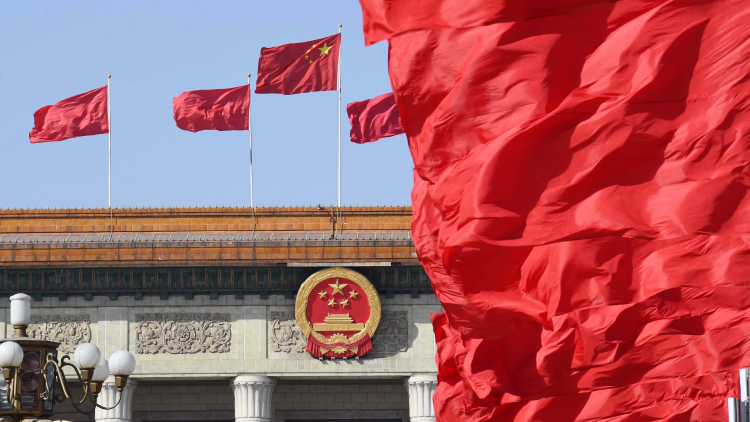

The new legal arsenal, approved on Thursday by China’s parliament, comes a week after President Joe Biden’s administration expanded a blacklist of Chinese companies in which Americans will be barred from investing, in the name of national security.
China passed a new law to counter foreign sanctions, a text that could confront multinationals with serious geopolitical dilemmas between Beijing and the West.
The new legal arsenal, approved on Thursday by China’s parliament, comes a week after President Joe Biden’s administration expanded a blacklist of Chinese companies in which Americans will be barred from investing, in the name of national security.
China deplored the move and vowed to take measures to “defend” its companies.
Why a law?
The 16-article law took effect on Thursday immediately upon enactment.
Its aim is to “protect” any Chinese person or organization in the event that a country “uses various pretexts or its laws” to take “discriminatory” measures against them.
Although no country is explicitly named, Beijing has long complained about the extraterritorial application of U.S. legislation through sanctions and trade restrictions.
The new law legalizes retaliatory measures, which can be “suspended, modified or rescinded,” according to the text.
What does the law provide?
Among other things, the denial of visas and entry into Chinese territory for individuals targeted by the law, and for their families as well.
The text legalizes the “sealing, seizure and freezing of assets” of individuals or companies that apply sanctions against China.
It also opens the door to the use of unspecified “other measures.”
The vagueness of the text “can potentially affect many individuals and companies,” Angela Zhang, an expert in Chinese law at the University of Hong Kong, told AFP.
“This broad framework means that many people, such as academics, experts and think tanks, could be sanctioned for supporting sanctions on China,” warns Julian Ku, an expert in international law at Hofstra University.
What are the consequences?
For multinationals caught in the middle of the rivalry between Beijing and the West, “the effect is likely to be devastating,” warns Zhang, although she believes Beijing will only use such sanctions “if necessary,” but “not immediately.”
Above all because this “would heighten anxiety” in the foreign business community and would be “costly” for Beijing in terms of investment.
Foreign companies will be tempted to relocate their production outside China, thereby accelerating a decoupling that is “contrary to the interests” of Beijing, which wants to preserve employment, the expert notes.
But the new law will inevitably pose a “real dilemma” for foreign companies in China, said Ku, referring to whether to comply with U.S. sanctions and risk Chinese retaliation, or vice versa.
Some companies may end up “lobbying their governments” to lift sanctions against China, says Angela Zhang.
What are the reactions?
Foreign companies will have to “navigate a new legislative minefield,” lamented the European Union Chamber of Commerce in China.
The U.S. Chamber of Commerce, for its part, said it hoped its companies “would not be forced to choose one side over the other.”
On the contrary, the law provides a “stable and predictable” legal and business environment, Chinese diplomatic spokesman Wang Wenbin told reporters.
Is it really new?
Against the backdrop of rising tensions with Washington in the final weeks of Donald Trump’s term, Beijing had announced rules in January to respond to “unjustified” decisions against China.
Those measures, which were very vague, already gave Chinese individuals and entities targeted by foreign sanctions the option of taking “countermeasures” — and also of pursuing legal action in China.
More broadly, foreign companies are regularly targeted by Chinese nationalists, who do not hesitate to denounce them on social media at the slightest offense.
In March, Swedish clothing giant H&M and several foreign brands came under fire and faced boycott calls over their stance on human rights.
Last year they had pledged to stop sourcing cotton from Xinjiang due to suspicions of “forced labor” in this Muslim-majority region of northwestern China.
Source: El País

