




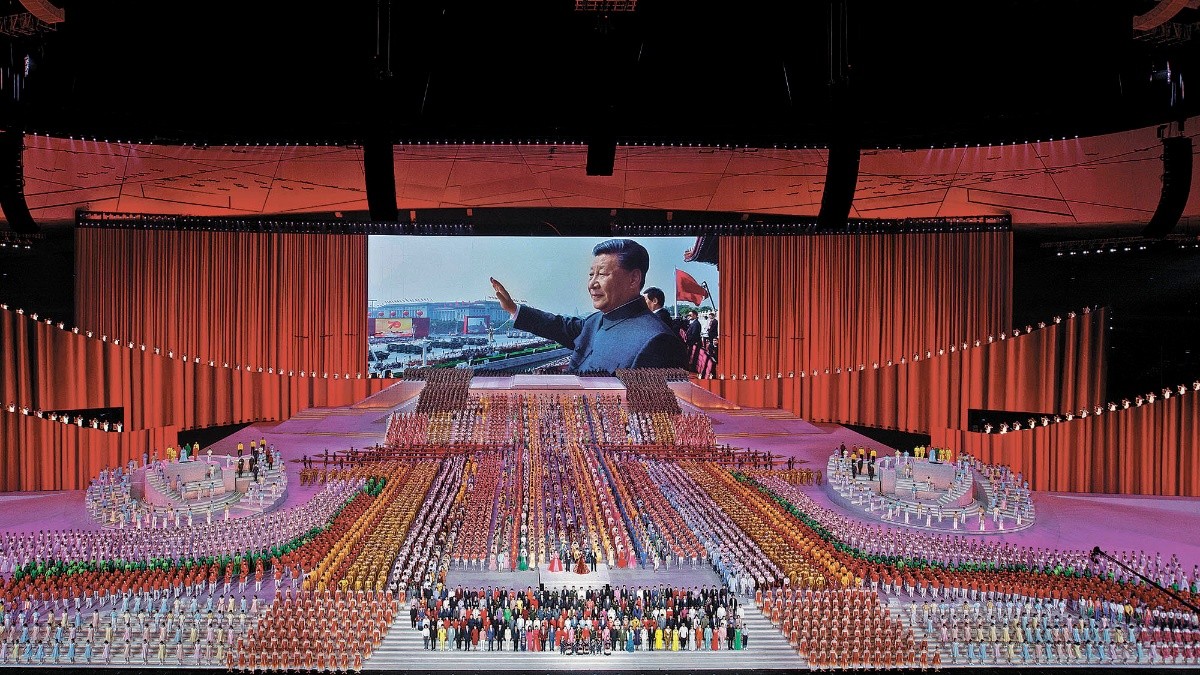

“The East is rising while the West is in decline,” said Chinese leader Xi Jinping during the ceremony commemorating the first centenary of the Communist Party of China. Xi’s message was part of celebrations that portray a more assertive China, ready to claim a greater leadership role in the world. In this narrative, the Communist Party is key. It presents itself as a model of order and effectiveness for generating economic growth and maintaining social stability. Unbeatable in crisis management, as with the pandemic. All of this in contrast to the “ineffectiveness” and chaos produced by Western democracies.
When will China become the world’s largest economy? Projections indicate this will happen between 2028 and 2035. Its nominal GDP stands at around 16.6 trillion dollars, versus 22.6 trillion for the United States, but the gap is closing. In 2020, China was the only major economy that did not contract, posting growth of 2.3 percent. It is projected to grow 8.5% in 2021 and above 5% in the coming years. The United States, meanwhile, saw a 2.3% contraction in 2020 and is expected to grow 6.5% in 2021. A stabilization will follow, in the range of 2 to 3% per year.
In terms of GDP per capita, China remains far below the United States. The Dragon stands at around 16,500 dollars per capita, versus 65,000 for the United States. That seems very far off, but the Asian country’s capacity to generate wealth should not be underestimated. Its GDP per capita was 317 dollars in 1990. Never in human history had so much wealth been produced in a single country in three decades. Over the same period, more than 800 million people were lifted out of poverty and a middle class of 400 million people was created, the largest in the world. For reference, the middle class in the United States numbers around 160 million people.
Having the world’s largest middle class provides arguments to challenge the United States for first place when it comes to the world’s largest domestic market. These 400 million consumers make China the country where the most automobiles are sold, along with the most smartphones and the most athletic footwear priced above 80 dollars a pair. In the ultra-luxury market, China is also El Dorado for firms such as Louis Vuitton, Gucci, Moet Chandon, and Cartier, among others. It has 4,446,700 people with a net worth above one million dollars and 626 people worth more than 1 billion dollars.
The list of Chinese billionaires was headed in recent years by Jack Ma, the founder of Alibaba, but the Chinese authorities have put a ceiling on this businessman’s growth, apparently because of his libertarian leanings and his habit of criticizing the authorities’ excessive regulation of business. China’s new champion among billionaires is Zhang Shanshan, a discreet man who owns the country’s largest bottler of water and tea. His fortune began with the Nongfu Spring brand and grew in 2020, thanks in part to his stake in a pharmaceutical company that manufactures COVID-19 vaccines.
China has eradicated extreme poverty. It has a middle class, millionaires, and billionaires. It is advancing rapidly in scientific and technological development and has become the country that registers the most patents, in addition to being one of the leaders in the promising field of artificial intelligence, which may well define who is who in the coming decade. It has come a long way, and the United States is within a stone’s throw, but it will only be able to claim the title of the world’s leading economic power when its currency, the renminbi, achieves as much acceptance as the dollar. This changing of the guard, if it happens, will take more than a decade. The big question is: will it happen peacefully?
Source: El Economista


