




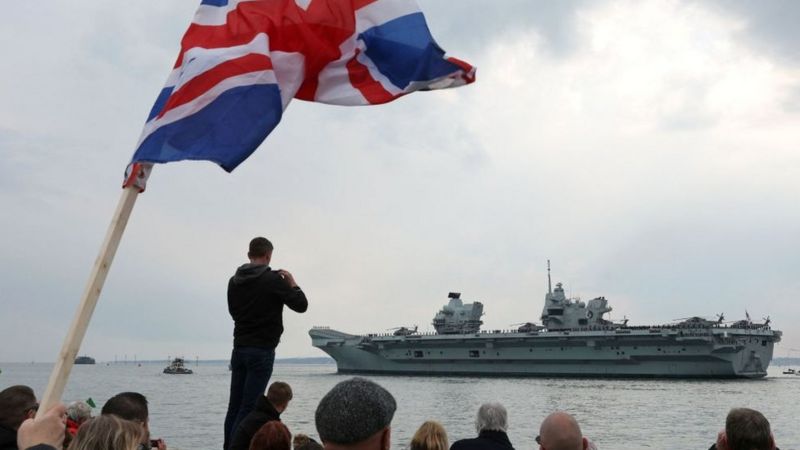
The Aukus Deal: Why China’s Growing Influence in the Indo-Pacific Worries Australia, the United States and the United Kingdom

Aukus, the historic pact announced on Wednesday by U.S. President Joe Biden in a video summit alongside his British and Australian counterparts, continues to cause a stir.
China asserts that it “seriously undermines peace and stability” in the Indo-Pacific region and “intensifies the arms race”.
At the same time, the French media see it as a heavy blow to French diplomacy and its arms industry. Aukus puts an end to a multibillion-dollar agreement between France and Australia, which had been celebrated in Paris as the “contract of the century”, to build 12 submarines to be used by the Australian navy.
“It really is a stab in the back”, lamented France’s Minister of Foreign Affairs, Jean-Yves Le Drian, on Thursday on the broadcaster France Info.
Aukus, an acronym for Australia, the United Kingdom and the United States, aims to “defend” the interests of the three Anglo-Saxon nations in the Indo-Pacific.
The agreement will allow Australia to build its first nuclear-powered submarines using U.S. technology. Washington had only ever transferred its technology to the United Kingdom, more than 50 years ago.
But why is this pact emerging now?
The world’s economic center of gravity
Although U.S. officials have said the move is not intended to counter China, experts assert that the Aukus agreement marks a shift in strategy and policy across the entire region.
“The Indo-Pacific has become key to the economy of the entire world. You could say it has become the center of gravity of the global economy, and not only because of China, but because of Japan, South Korea, India, among other countries”, Ramon Pacheco Pardo, professor of International Relations at King’s College London and an expert on Asia-Pacific, tells BBC Mundo.
The Indo-Pacific region is home to the world’s two most populous nations, China and India, and adding other countries such as Indonesia, it hosts more than half of the world’s population.
Likewise, it accounts for nearly half of the planet’s economic output, home to the world’s second- and third-largest economies (China and Japan), in addition to India, which is growing rapidly, and South Korea, which remains in the top ten of the world’s largest economies.
The United Kingdom’s outgoing Foreign Secretary, Dominic Raab, knew it.
“If you look at India and the Indo-Pacific region and take a long-term view, that is where the growth opportunities will be“, he said during a visit to India in December of last year.
The Chinese threat
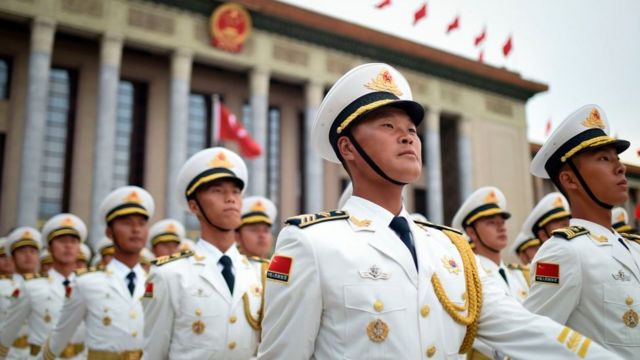
Beyond the region’s enormous economic and demographic weight, the United States and its Western allies are concerned about the growth of China’s presence, as well as its actions in the area and the way it is arming itself.
Speaking to the BBC, the United Kingdom’s Defence Secretary, Ben Wallace, recalled that China was “embarking on one of the biggest military spends in history“.
“It is growing its navy (and) its air force at a great rate. It is obviously involved in some disputed areas”, he added.
“Our partners in those regions want to be able to defend their own ground (…) It is not about antagonizing anyone”.
China has been accused in recent years of raising tensions around disputed territories in the Indo-Pacific.
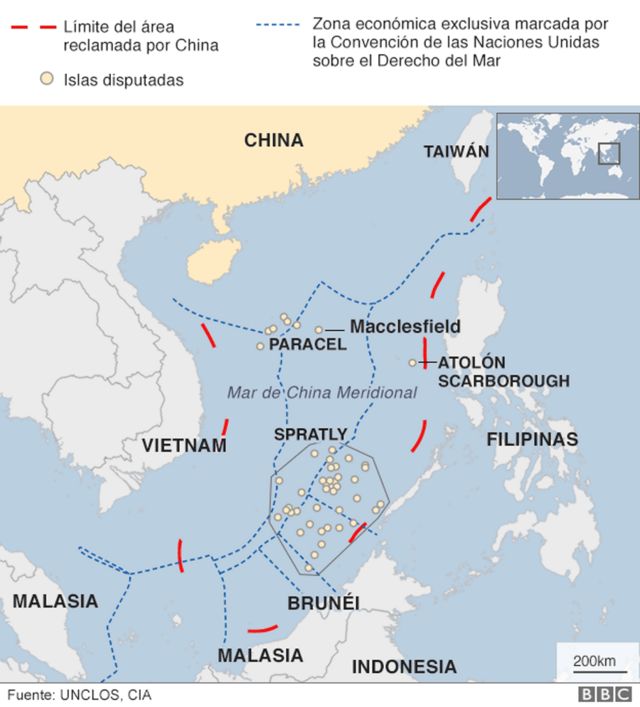
Beijing claims almost the entirety of the South China Sea as its own, and under Xi Jinping’s leadership it has built everything from cities to airstrips and tourist and military facilities on artificial islands in the area.
But these are waters also claimed by countries such as the Philippines, Vietnam, Taiwan, Malaysia and Brunei, which has created a dispute over numerous islands, reefs and their respective adjacent waters that has gone unresolved for decades.
30% of world trade passes through this area
Although the U.S. does not raise sovereignty claims, it does display its military presence under the argument of defending “freedom of navigation” in a strategic area through which 30% of world trade circulates.
The area is also believed to hold prized deposits of oil and gas.
Veerle Nouwens, an expert in Asia-Pacific geopolitical relations at the London-based RUSI Institute, asserts that both the region’s projected economic growth and its maritime routes make it a “direct national interest” for countries both inside and outside the region.
In her view, the region requires stability and an order based on international rules.
“But growing geopolitical tensions, particularly regarding China’s military assertiveness, worry London and Washington, as well as partners in the region, who find themselves dwarfed by Chinese economic and military power“, she adds.
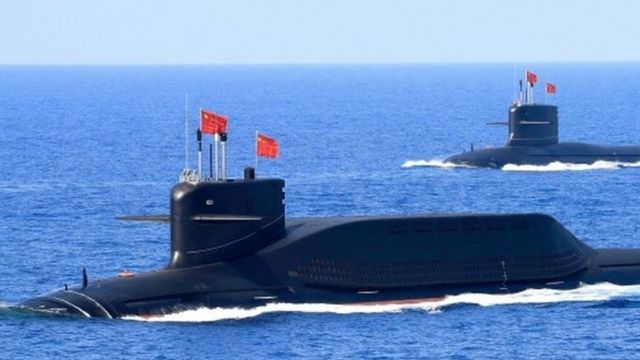
Pacheco Pardo, of King’s College London, believes Aukus will increase the West’s power and weight in the region: “This could serve to contain China’s behavior in the Indo-Pacific”.
“It changes the balance of power in the region”
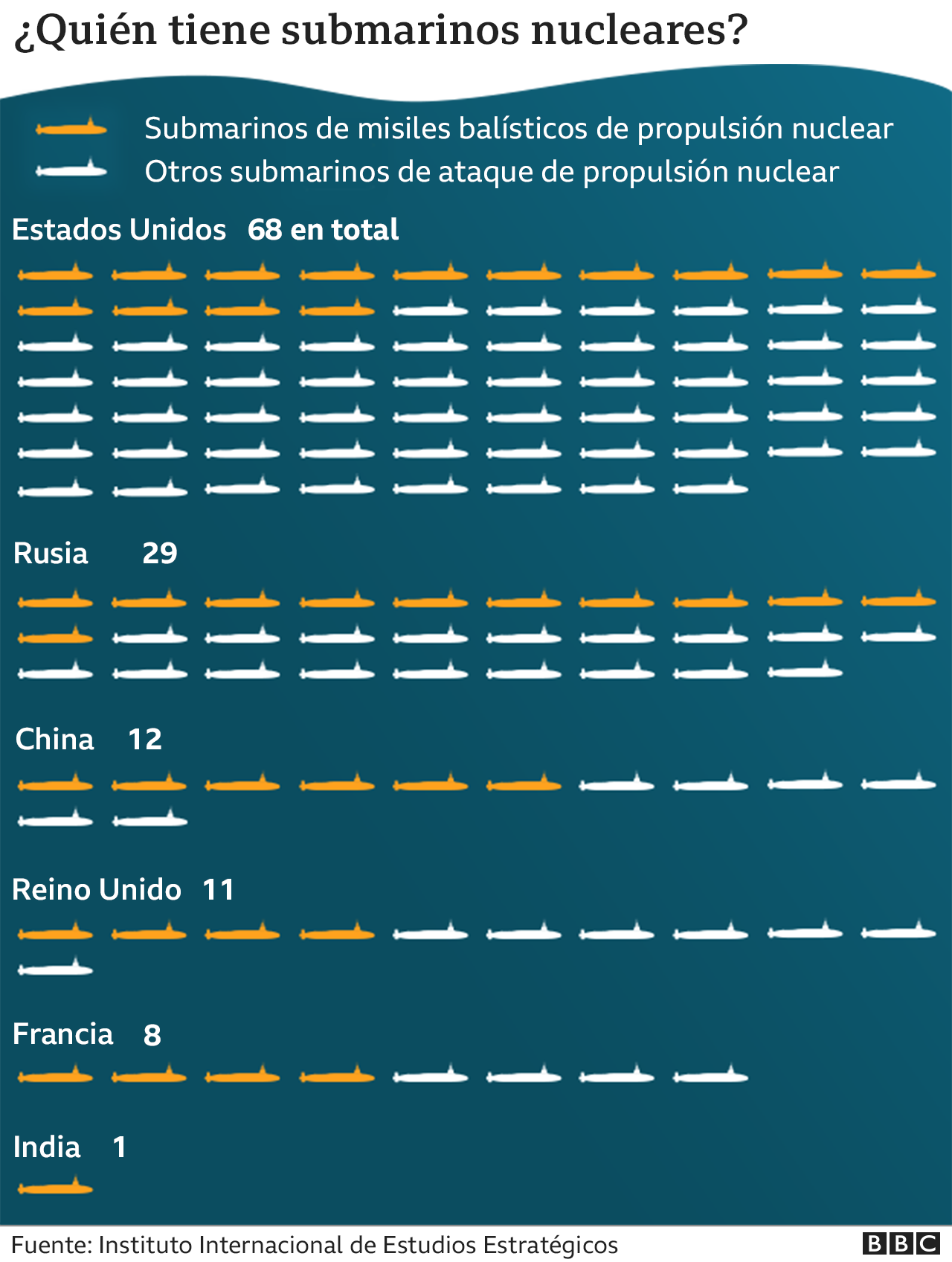
With this pact, Australia will join an exclusive and small group of nations operating nuclear-powered submarines, which includes the United States, the United Kingdom, France, China, India and Russia.
Australia has insisted that it has no intention of developing nuclear weapons and will continue to comply with the Nuclear Non-Proliferation Treaty (NPT).
Nuclear-powered submarines are much faster and harder to detect than conventionally powered ones. They can stay submerged for months, fire missiles over longer distances and also carry more weight.
“The fact that Australia has nuclear submarines does not make it more powerful than China (…) But it changes the balance of power in the region”, Yun Sun, co-director of the East Asia Program at the Washington-based Stimson Center, told the BBC.
“If China faces a security situation in the South China Sea or the Taiwan Strait, this will affect the readiness and response of China’s Armed Forces”, she adds.
According to analysts, having this type of submarine stationed in Australia is fundamental to the United States’ influence in the region.
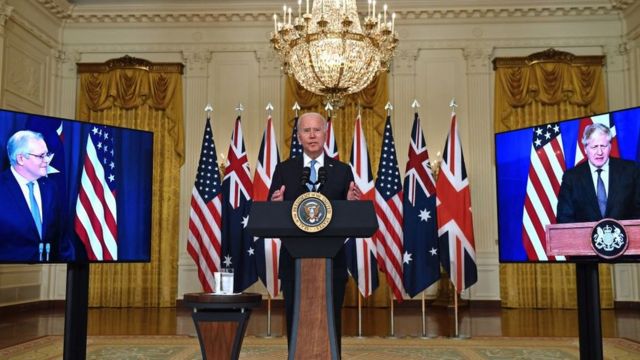
But one of the immediate consequences for Australia has been that the pact has poisoned its relations with China.
On Thursday, several Chinese state media outlets published editorials denouncing the pact. The Global Times went even further, asserting that Australia had “turned itself into an adversary of China“.
Aukus was born a month after the United States’ hasty and much-criticized withdrawal from Afghanistan.
Ramon Pacheco Pardo, of King’s College London, does not believe the two events are linked, but he judges that the agreement represents a great opportunity for Washington to refresh its image and show that, despite not having consulted its allies on its decision to leave Kabul, it is still willing to work with them.
But for expert Veerle Nouwens, this simply demonstrates that the Indo-Pacific has become a priority arena for the Biden administration.
Source: BBC


