




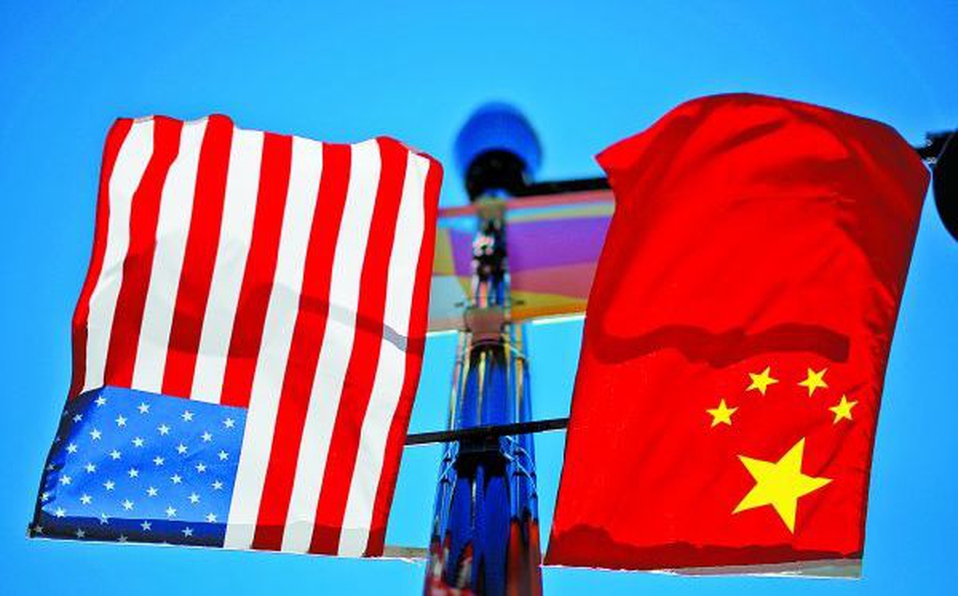

Experts debate whether to benefit from integrating Beijing into the system or to fight an increasingly repressive enemy https://www.milenio.com/negocios/financial-times/relacion-eu-china-trazara-futuro-global
The relationship between China and the United States will shape the future of the world in all its dimensions. Unfortunately, those relations have been deteriorating for a long time. In fact, perhaps the only issue on which Republicans and Democrats agree is that China is an enormous threat to US interests and values.
Aaron Friedberg, of Princeton University, enthusiastically shares this view. In fact, his biggest complaint is against those who once believed something different. Fred Bergsten agrees that it is a very difficult relationship, but takes a different perspective on the threat.
Bergsten is a dean of American thinkers on international economic policy. The founder of the Peterson Institute for International Economics has devoted his life to promoting the liberal international economic order. His book, The United States vs. China, starts from the idea that preserving that order should be our main objective. It also focuses on the economic aspects of the bilateral relationship, arguing that “it would be far superior, from both the US and the global perspective, to decouple economic issues from the inherently contentious ones of security and values.”
Friedberg considers this naive. For him, economics cannot be separated from politics. The Chinese Communist Party is, he argues in Getting China Wrong, a Leninist organization devoted to its own power. It is simple: “Beijing believes that rivalry with the West is inescapable and that the stakes are existential.”
Bergsten’s analysis is framed in terms of the “Thucydides trap” and the “Kindleberger trap.” The first concept comes from Graham Allison of Harvard, who started from a pattern first identified by the great historian of the Peloponnesian War, in which a rising power (Athens) clashes with an established one (Sparta). The second concept comes from the late Charles Kindleberger, who argued that the interwar economic disaster was largely due to Britain being too weak to act as the hegemon the world economy needed at the time, while the US was too inward-looking to do so. In their economic relations, Bergsten argues, the United States and China may now fall into the Thucydides trap. In doing so, they will also open the Kindleberger trap.
The relationship between the US and China is different from that of the Cold War, which was an ideological and security conflict. Both sides were locked in a competition, which the Soviets lost, but they were economically decoupled from each other. China, however, has built an economy that already matches that of the United States in many dimensions. Moreover, China and the West are interconnected with each other and with the rest of the world on the economic side.
Bergsten concludes from these realities that the US must “reject any effort to contain China. Even if it were desirable, containment cannot succeed, as President Trump demonstrated. China is too big and dynamic to be repressed, and few countries, if any, would join the United States in an effort to do so.”
Fortunately, this will be unnecessary, since China is a “revisionist rather than revolutionary power.” Bergsten’s main recommendation is what he calls “conditional competitive cooperation.”
Competition “will characterize much of their daily interaction through trade, investment and financial exchanges.” But cooperation is essential to “lay the foundations of a stable and successful international economic order.” Conditionality will also be necessary, as both sides “will rightly insist that the other accept and faithfully implement the agreed rules of the game governing their interactions.”
This leads to 10 policy recommendations. Among them: that the US once again play a leadership role, that everyone continue to defend the current system and prevent its erosion, that there be a new multilateral trade package and that, over time, China even be granted full parity of quotas and votes with the United States in the International Monetary Fund.
The most important recommendation, Bergsten concludes, is that the US undertake “a broad program of domestic economic and social reforms to restore a sustainable political foundation that allows the country to once again exercise responsible global economic leadership.”
Friedberg’s analysis and recommendations are the opposite. “What is emerging today,” he states, “is an intense global rivalry — economic, technological, military, diplomatic and ideological — between two superpowers.” Whether we call it a “new Cold War” or use words like “containment” is neither here nor there.
“Engagement was a gamble rather than a mistake,” he argues, “but the odds were always extremely low.” A “more accurate perception” of the Chinese Communist Party regime may have instilled “a greater sense of realism about the chances of success and a greater sensitivity to early signs of failure.”
So what is to be done? Friedberg recommends four main lines of effort: “The United States and its partners must mobilize their societies for a prolonged rivalry with China and harden them against the Chinese Communist Party’s influence operations; decouple their economies from China’s while strengthening ties among themselves; step up military preparations and diplomatic measures to deter coercion or aggression; and challenge Beijing’s ideological narratives, both in the developing world and, to the extent possible, within China itself.”
The two books differ on almost everything. However, they agree on two points: first, alliances with other liberal democracies are an immense asset for the US, especially in the economic struggle; second, Donald Trump was a catastrophe, not least because of his inability to recognize this reality.
The main value of the books is that they set out their opposing views with great clarity. Bergsten focuses on the enormous potential benefits of bringing China into the system as an equal partner. Friedberg sees an increasingly repressive, deceitful and irreconcilable enemy.
There are other perspectives. One is that the US, not China, is the more aggressive power. The United States has fought a series of foreign wars in recent decades; China has not. It insists on strategic supremacy; China does not. The US has 800 military bases abroad; China has only one. Moreover, under Donald Trump, the United States broke many of its international commitments, especially those of the World Trade Organization (WTO). The US may regard its actions against China as merely defensive. It is no surprise that China (and others) see them differently.
Again, Friedberg is a moralist. He insists that the Chinese Communist Party, not China, is the enemy. But international realists will argue that ideology does not matter as much as China’s actual and potential power: friction is inevitable.
I find Bergsten’s aspirations appealing and Friedberg’s vision depressing and one-sided. But the latter’s perspective seems destined to win. This is due, in part, to the fact that the drive toward economic separation feeds on the deep distrust on both sides.
Also important are the Chinese regime’s increasing repression and the resurgence of one-man rule. Above all, China’s support for Russia’s invasion of Ukraine and its attempt to separate Europe from the United States are unacceptable. China, unfortunately, chose to be the enemy of the West. I do not know whether Friedberg’s world was inevitable. It will now be difficult to escape it. This will prove to be a tragedy for humanity.


