




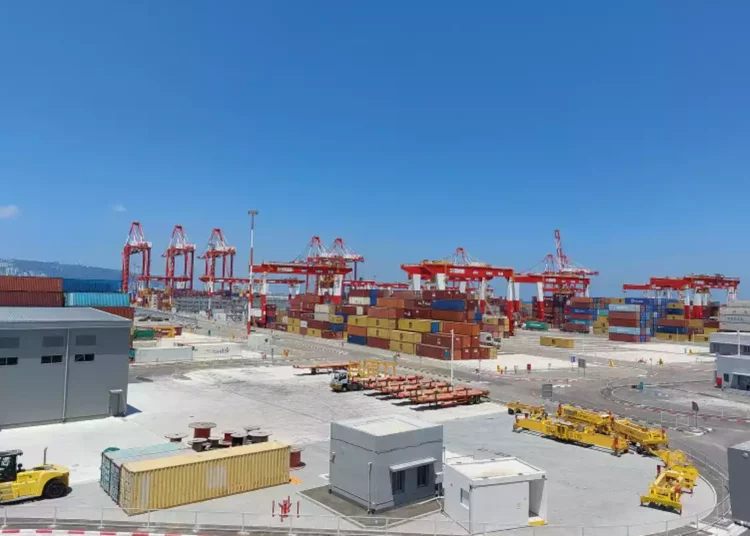

The latest terminal at the port of Haifa is a technological marvel, and although some share concerns, the benefit seems far greater than the risk.
An aerial view of Haifa explains its reputation as a port city: a large part of its coastline is dotted with ships berthed at its various shipping ports, and there is rarely a shortage of vessels off the coast waiting to dock and bring their goods ashore.
Although the origins of the port of Haifa date back to the years when the country was ruled by the British, and the bay itself has a long history of imports and exports going back to roughly 1400 BCE, there is a very young and very advanced new kid on the block: SIPG Bayport Terminal.
This simple name denotes the latest addition to the Haifa coastline: a privately owned and operated seaport (or “terminal,” as ship people call it) 800 meters long and 17.3 meters deep. It became operational in September 2021 and was built by its current owner, SIPG (Shanghai International Port Group).
The SIPG Bayport terminal, the first of its kind in Israel, has the capacity to process one million shipping containers per year. Perhaps the most interesting logistical facet of the new port is that, despite its enormous throughput capacity, it is staffed by only about 100 people.
This remarkably low headcount is made possible by the vast amount of automation technology built into the port’s DNA. From container tracking to contact with drivers, to loading and unloading, most of the work carried out at the terminal is done automatically.
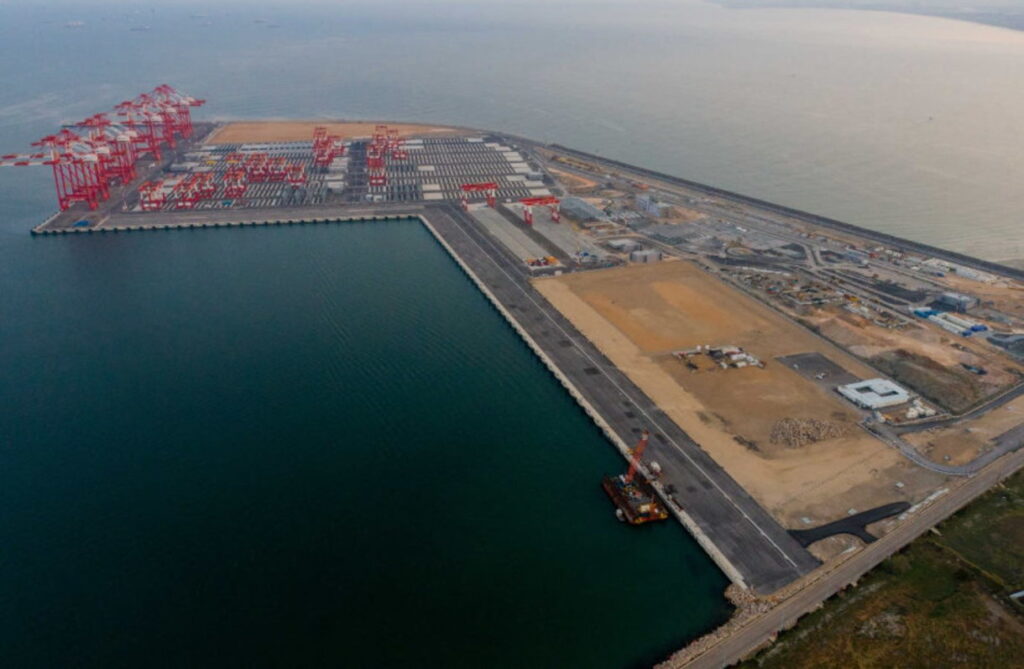
Look, Mom, (almost) no hands
During a visit, I was able to see the soul of the terminal up close: eight autonomous 100-meter gantry cranes proving that you can, indeed, get vertigo looking up from the ground. Each of these cranes handles the unloading of 25 shipping containers per hour, 24 hours a day, from the ships berthed at the terminal. The cranes receive orders, retrieve specific containers on a very tight schedule, and then lower them onto the trucks waiting below, to be moved to the storage yard and taken to their final destinations.
Something like 90% of that work is done entirely on its own, with human intervention only during the last few meters (to prevent any possible trucker-panic incident resulting from a robot’s underappreciation of human life). To that end, in a nearby building there is a group of crane operators, each manning a battle station with monitors, joysticks and tempting buttons that journalists want to touch, but get scolded for doing so.
“I’m not that stressed,” a crane operator told me after I explained that, if I were in his place, I would need six beers a night to unwind from the stress of moving two-ton boxes through the air over living human beings by remote control. “It just takes a lot of experience. You have to know how to handle the controls; you have to know how to read the maps, take on additional responsibilities. It’s a job that requires you to pay attention.”
These crane operators work in three shifts, so that the terminal can unload cargo constantly: all day, every day.
This is one aspect that sets the Haifa Bay port apart from its sibling in Ashdod, built under the same initiative: by not operating constantly, the Ashdod terminal will not be considered very productive from a global perspective. Exporters want to know that any ship they send to unload can be processed quickly and efficiently, and taking the weekend off (as Ashdod does) is a fairly harsh mark against a seaport’s perceived efficiency. By contrast, the Haifa Bay port’s uninterrupted activity is expected to place it high in the hypothetical “port league tables,” once it gains momentum.
Recipe for a new port
So, how do you build a NIS 3.98 billion maritime terminal? If you want to do things the Israeli way, you offer a 25-year ownership tender and wait.
At that point, shipping companies like SIPG will bid for the opportunity to own and operate one of the most advanced terminals this side of the Fertile Crescent, and once the winner is decided, they are presented with an 800-meter-long bathtub full of sand, handed a blueprint you have drawn up, and told to start building.
Although such an offer is steeped in Israeli chutzpah, companies like SIPG are willing to bite. The company wasted no time in building the entire port terminal: asphalt, buildings, cranes, electrical infrastructure, communications equipment… SIPG took care of everything.
It makes a lot of sense for it to accept the tender’s conditions: access to the Middle East market through Haifa has been a coveted economic asset for hundreds of years, and China’s profit potential is staggering.
But what is the thorniest edge of the deal? At the end of the tender’s 25 years, SIPG steps away and leaves the entire terminal to Israel to put out to bid again in the next tender.
Although SIPG was the sole bidder in the first tender (which carried the baggage of building everything from scratch), the next tender may offer more competition, and SIPG will be quite incentivized to reclaim its hold on the terminal in 2046.
“We want to operate this terminal for a long time,” said the company’s general manager, Miao Qiang. As we sat in his simple, elegant office at the terminal’s headquarters, he explained that, since they built it, it is in SIPG’s interest to stay.
“This is the first port we have invested in outside of China, so we would like [to win the next tender], but that is not something we can decide,” he said; it is only something they can bid well on and hope.
For now, SIPG is focused on recouping its enormous initial investment. “We hope to recover our investment as soon as possible, but for a port — especially a container port — it takes a long time,” Qiang said.
He explained that, because the terminal is so young, its initial profits during the first years of operation are expected to be quite low.
“We can recover our investment after 10, 15 years, or maybe more,” he said.
That is a fairly high estimate, but 10 solid years of profits doesn’t sound bad at all.
Some concerns
At last week’s Cyber Week 2022, a tall man named Adam Meyers gave a presentation on tracking cyber threats. Meyers is the head of intelligence at CrowdStrike, an industry-leading U.S.-based cyber threat intelligence company that tracks, classifies and reports on cyber threats from dozens of nefarious entities and actors.
During his presentation, Meyers mentioned in passing the new port terminal and how it could be a foothold for cyber espionage. After his presentation, I sought Meyers out in the crowd of conference attendees and asked him to tell me more about CrowdStrike’s position on the terminal.
Something important to note is that during my visit to the terminal, I was assured that the bay port is not associated with the Chinese government; it is simply operated by a Shanghai-based company.
However, as far as CrowdStrike is concerned, that distinction is blurry at best.
“Everything is connected,” Meyers said. “If you start digging into the chain of who owns whom, you find state-owned companies with Chinese Communist Party members on the board and investing in them. Chinese companies are inextricably linked to the Chinese government.”
To that end, Meyers continued, they are interested in a variety of projects and deals they can use both to increase their influence from a strategic perspective and to grow their economic power.
“Here in Israel, they are building a port in Haifa, they are involved in the Tel Aviv metro project. All of that comes with the incorporation of Chinese technology; it comes with them having people in the country; it comes with them having more access. And with that usually comes cyber espionage.”
It is not unheard of for Chinese espionage to occur in situations like this. In 2018, news broke that China had built the African Union headquarters while simultaneously planting Huawei cameras to spy on the activities carried out there. At the time, the French news site Le Monde reported that, for five years, data had been transferred every night from the computers in the Chinese-built building to Chinese servers.
It follows that having access to the information in the port’s databases could provide the Chinese government with very useful intelligence, assuming SIPG is collaborating with the Chinese state.
“In the long term, knowing what goes in and out of that port is important to them in terms of having a negotiating strategy when they talk to the Israeli government again,” he said.
“They want to send ships; they want to have influence and control in this region, in this country and in that port, so they can start driving the narrative.”
So, in the event that the Shanghai-operated bay port is, in fact, in league with the Chinese government, how should Israel stay vigilant?
“Going into everything with [both] eyes open is fundamental. Maintaining that level of visibility gives you the ability to prevent them from having leverage against you,” Meyers said.
“To be fair, I think China is doing what is in its own interest,” Meyers concluded. “However, they are not necessarily doing what is in Israel’s interest. Israel has to do what is in Israel’s interest.”
Wrapping up, shipping out
Meyers makes a compelling argument, but that does not mean he is right. There is no concrete evidence that the Chinese government conducts espionage through this port. What is concrete is the economic value the bay port holds for both the Chinese and Israeli economies.
Backing up Meyers’ claims, in recent years there has been a series of warnings from the U.S. government against Israeli collaboration with the Chinese in the construction of critical infrastructure, as it could give rise to intelligence breaches.
These warnings influenced Israel’s decision not to move forward with the China Railway Construction Company in building the green and purple lines of the Tel Aviv light rail.
Even in a situation where the Chinese government is trying to outmaneuver Israel through cyber espionage, the latter’s industry-leading cybersecurity technology could be up to the challenge – and at the end of the day, Israel now has an impressive and technologically advanced port in the North.
Source: Noticias de Israel


