




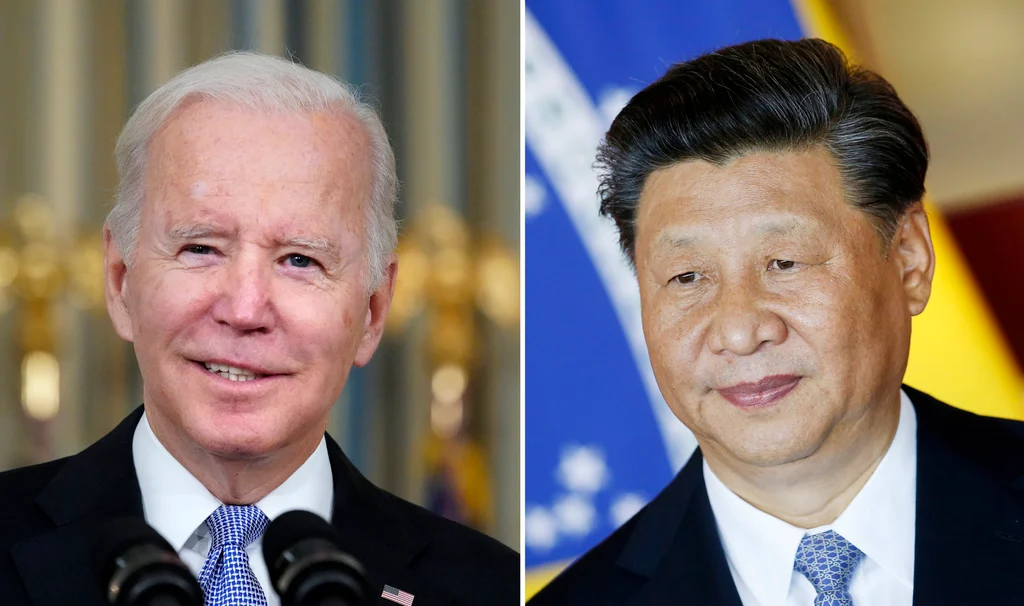
The United States and China are on a knife’s edge over Taiwan ahead of a phone call between Xi and Biden

No one can afford to look weak.
The latest U.S. standoff with China was triggered by leaked plans for a possible visit to Taiwan by House Speaker Nancy Pelosi, and it is particularly dangerous because it is driven by domestic politics on both sides of the Pacific.
The dispute is worsening already poor relations between the United States and China as their 21st-century superpower struggle takes shape. It also complicates a call scheduled for Thursday between U.S. President Joe Biden and Chinese leader Xi Jinping.
Taiwan has long seemed the most likely spark for a military escalation between the U.S. and China.
Under the complicated web of agreements governing relations with Beijing, Washington grants formal diplomatic recognition only to the People’s Republic of China, but maintains close ties with Taiwan, a self-governing democracy over which China claims sovereignty.
The U.S. policy of strategic ambiguity has left it unclear what it would do if China ever invades Taiwan, in part to avoid encouraging a formal declaration of independence by the government in Taipei. But the United States is required by law to provide Taiwan with the means to defend itself.
China has vehemently warned that it will take “resolute and forceful” measures if Pelosi visits. An attack on her plane is unthinkable. But there is speculation in Washington that China could shadow her U.S. military aircraft with fighter jets or even send planes to fly over Taiwan itself, a highly volatile scenario fraught with tension over the possibility of a miscalculation.
Given that rhetoric, it would be difficult for China not to take unprecedented measures if Pelosi makes the visit. Xi has little room for de-escalation ahead of a national party congress later this year, which is expected to confirm his unusual third term.
Biden, perhaps unwisely, revealed that the U.S. military was not enthusiastic about Pelosi’s visit. Now, if he convinces the House Speaker not to go, he will be accused of caving to the Chinese, a burden no U.S. president can tolerate, especially one whose approval rating has plummeted below 40%.
Pelosi, the third-highest-ranking figure in the U.S. government, has been sparring with China over human rights for 30 years and is not the type to be intimidated. With Democrats at risk of losing the House in November’s midterm elections, she will not be willing to let what could be one of her last big plays on the international stage turn into a climbdown before Beijing.
The White House, eager to avoid offending a Democratic icon and aware of the political sensitivity of trying to strong-arm another branch of government, has been talking with Pelosi behind the scenes about the risks of her trip, according to CNN reports.
On Capitol Hill, aggressive advice is coming from both sides of the aisle.
“We should not allow them to bluster and dictate to the United States, the greatest nation in the world, where our House Speaker should travel,” progressive Democratic Rep. Ro Khanna of California said on CNN’s “The Situation Room” on Tuesday. “I mean, who are they to say that Speaker Pelosi shouldn’t go to Taiwan?”.
Republican Minority Leader Kevin McCarthy weighed in, saying Pelosi “shouldn’t back down now.” He also said he would lead a congressional delegation to Taiwan if he becomes House Speaker next year, although that visit would potentially be less explosive than Pelosi’s, since Biden could argue to the Chinese that rival Republicans do not represent his policy.
Given the political tensions on both sides, it is hard to see how Biden and Xi can defuse the situation.
Things could get complicated if Xi asks Biden to prevent Pelosi’s visit. Biden has no power to make that happen. But the Chinese leader could take offense if the House Speaker makes the trip, which would further fracture trust.
China, which is increasingly capable militarily, is also watching bipartisan calls on Capitol Hill for strategic ambiguity to be abandoned and for the U.S. to simply declare that it will defend Taiwan. Biden has not exactly helped by repeatedly making statements that leapfrog the entire policy, only for his aides to walk them back.
Bonny Lin, director of the China Power Project at the Center for Strategic and International Studies, said the best that could come out of the call is perhaps a mutual understanding of what exactly China would do if Pelosi goes.
“Hopefully, there is something the Chinese can give us in terms of understanding how China might respond so that the U.S. and Taiwan can plan in a way that does not generate further escalation in this dynamic,” Lin said.
But China may not yet know how it would respond, she added. And it may not be interested in measures that de-escalate the situation.
Much depends on what Pelosi decides to do.
Source: CNN en Español


